As part of International Women in Engineering Day we‘re celebrating some of the ’Minds Behind MASTA’. Read our interview with Dr Hope Fisk, Software Engineer and Analyst at SMT as she shares more about her role, career journey and the work she is doing now to push MASTA even further ahead.
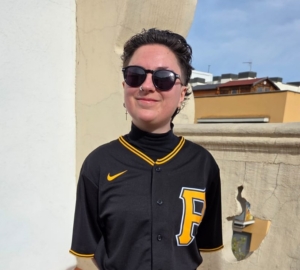
Dr Hope Fisk, Software Engineer and Analyst, SMT
- What does a typical day look like in your role?
“There’s usually a main task I’m working on, but I don’t tend to structure things too rigidly. I like to just dive into the problem I’m trying to solve and see where it takes me.
A lot of my work is focused on developing bearing models, so building on what already exists, but also figuring out areas we don’t fully understand yet. That might be changes to geometry, how a bearing behaves in a particular system, or how it interacts with other components.
There’s a lot of freedom in how we approach challenges at SMT. Everyone has their own area of focus to work on, but there’s also space to just stop and think, explore different ideas, and go down different paths depending on what feels right that day.
I personally work best when I can follow that curiosity and see where it takes me. It’s not very linear, but that’s kind of the point.”
- What first inspired you to pursue engineering?
“Engineering was always in the background for me, but I didn’t initially think it was something I’d go into. My dad worked as an engineer, a draughtsman, so I’d grown up around it and was always interested in how things worked. My mum was an accountant. She had actually wanted to be an engineer herself but had been told ‘that wasn’t really something women did’, which definitely stuck with her.
When I was applying to university and considering engineering, she suggested I might be better off doing something like maths instead. Partly because it kept more options open, and partly because engineering still didn’t feel like the obvious route for me at that time.
I’d always loved maths, so I went down that path, but throughout the course I naturally drifted towards engineering-related topics anyway. I think I was always going to end up here in some form.
The software side honestly came later. I hadn’t really done any coding before my PhD. I turned up and was told to learn Fortran, which was… an experience! But that process actually made me really comfortable with the way software works as a whole, rather than just focusing on the language itself. Then the rest just evolved from there.”
- What’s the most interesting or rewarding part of your work right now?
“What’s most interesting to me is how much we’re still learning, even with things that seem well established. When I started, I assumed a lot of engineering was already fully understood. But, especially with bearings, there’s still a lot we don’t know as an industry, or at least not in the level of detail we need to really match real-world behaviour when designing things.
That means the work feels genuinely exploratory. You’re not just applying known methods, you’re figuring things out, you’re really improving things, sometimes in quite niche areas.
I’ve always been drawn to that. Even during my PhD, I liked working on problems where I could contribute something new, even if it’s only a small improvement. It feels more personal, you feel like you’ve actually added something, rather than just followed a process to complete a task.”
- What’s something about your role that might surprise people?
“Probably how collaborative it is. I think there’s this perception that engineering is quite competitive or very individual, but a lot of my work involves talking to people, colleagues or customers, and working through problems together.
When I spend time talking with customers, maybe on a particularly challenging support query, I love that it’s never just a simple ‘yes or no’ answer. It’s more of a discussion, understanding what someone is trying to do, how they’re approaching it, what it is they want to achieve, and then figuring it out together.
That surprised me a lot. It’s much more of a dialogue than I expected and those conversations actually feed back into development, which makes the work a lot more interesting.”
- What advice would you give to someone considering a career in engineering?
“Find people you relate to, and don’t be afraid to acknowledge that. For me, having female role models (teachers, lecturers, people I met along the way) made a huge difference. It’s easy to downplay that and say it doesn’t matter, but it really does. Seeing someone like you doing something makes it feel more achievable.
And the biggest piece of advice I’d give is just to keep asking questions.
There’s often this pressure to feel like you should already know everything, especially in technical fields and that asking questions shows a lack of knowledge or ability. But asking questions is how you actually learn, and it’s something that’s genuinely valued in roles like this.
Curiosity is a strength. You shouldn’t feel like you have to hide it.”
- What skills have been most important in your role?
“Resilience is probably the biggest one. You get stuck all the time and that’s completely normal. I think there’s a tendency to think that if you can’t do something straight away, it means you’re not capable. And that’s not true at all, it usually just means you haven’t figured it out yet. Learning to work through that is really important.
The other important skill is being flexible in how you approach problems. You might start with a clear idea of where you want to get to, but the path isn’t linear. Sometimes you have to step back, change direction, or even accept that something isn’t going to work the way you expected. That ability to adjust when you need to, and not see that as failure, is really valuable.”
- What are you currently working on?
“At the moment, I’m working on developing models for roller bearings, which is really interesting because they’re much less uniform than ball bearings. With ball bearings, things are more mathematically ‘neat’. Roller bearings are more complex, they vary even within the same category, which can make them harder to model, but also more interesting.
There’s a big push towards using simulations to build confidence in a design before anything physical is built. Work like mine helps make that possible, which is really rewarding to be part of. My work is really exciting because it expands what we can represent in MASTA and brings us closer to modelling full systems more realistically.”
Click here to add your own text