How Researchers Used MASTA to Analyse Bearing Performance in a Cycloidal Drive with a planetary input.
Industrial robots have become essential to modern manufacturing, enabling high-precision assembly, machining and automated production. At the heart of many industrial robot joints is a component that most people never see – the precision reducer.
Among the most widely used precision reducers is the cycloidal drive with planetary input commonly referred to as an RV-type reducer, valued for its high torque density, excellent stiffness, compact packaging and positioning accuracy. These characteristics make RV-type cycloidal reducers a preferred choice for demanding robotic applications, including automotive assembly, welding, material handling and aerospace manufacturing. But achieving the level of performance required creates significant engineering challenges.
The internal bearings within an RV-type cycloidal reducer operate under highly complex loading conditions – loads continually vary as forces are transferred through the multi-stage drivetrain, cycloidal discs, crankshafts and supporting structures. Understanding how these loads affect contact stress, wear and fatigue life is critical to ensuring long-term reliability.
A recent peer-reviewed study published in Lubricants demonstrated how researchers from Suzhou University China combined theoretical modelling and MASTA simulations to investigate the behaviour of critical bearings within an RV-type cycloidal reducer, providing valuable insight into contact mechanics, load distribution and wear behaviour.
Why RV-type cycloidal Reducers Are Challenging to Analyse
During operation the cycloidal discs in a RV– type cycloidal reducer undergo a complex motion exhibiting a high-speed orbital motion due to the eccentricity in the crankshaft in addition to the slow speed rotation of the disc. This leads to complex loading conditions in the cycloidal mechanism. An animation of the loads in an RV-type cycloidal reducer during a single lobe pass can be seen below.
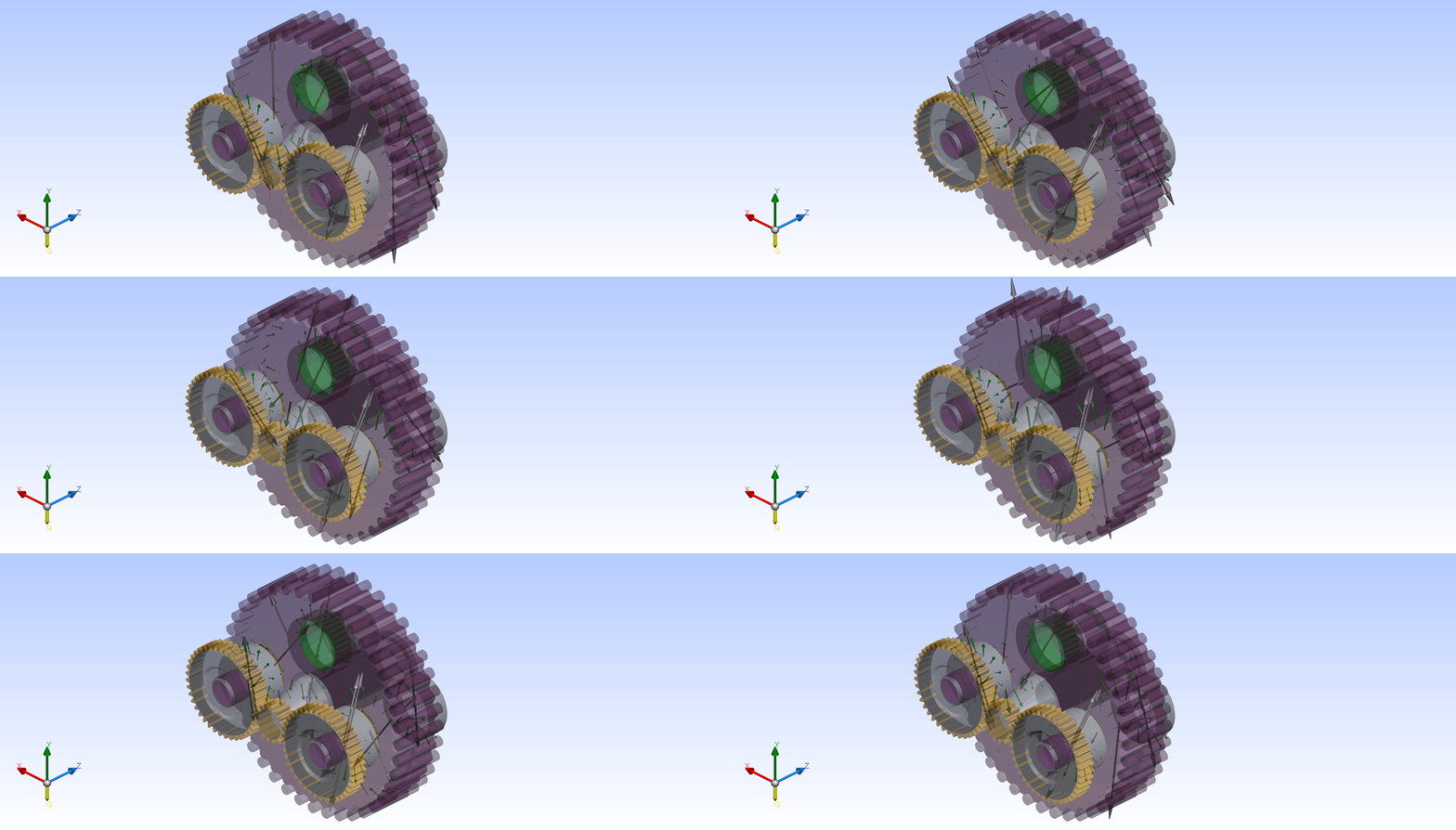
Each component influences the others and forces generated within the cycloidal mechanism are transmitted through bearings and supporting structures, creating complex contact conditions that can be difficult to evaluate using isolated component-level analysis. For engineers developing robotic drivetrains, understanding this system-level behaviour is often just as important as understanding the individual bearing itself.
Combining Theory with Simulation
To investigate these challenges, the researchers developed an integrated workflow combining analytical bearing models with a detailed MASTA simulation of the complete RV-type cycloidal reducer. The theoretical model was used to calculate load distribution, contact forces, contact stresses, sliding velocity and wear depth.
The MASTA model then provided a high-fidelity representation of the complete reducer system, including gears, bearings, shafts and supporting structures. This allowed the team to analyse detailed contact mechanics and compare the results against theoretical predictions. The objective was not simply to simulate the reducer, but to validate a methodology for predicting bearing performance and life within a complex robotic transmission system.
Building a High-Fidelity RV-type cycloidal Reducer Model
The researchers created a complete parametric model of the RV reducer within MASTA, incorporating:
- The planetary gear stage
- Cycloidal assembly
- Crankshaft arrangement
- Tapered roller bearings
- Needle roller bearings
- Representative operating conditions
Material properties, stiffness characteristics, torque loading and operating speeds were defined to replicate real-world operating behaviour as closely as possible. This enabled detailed investigation of contact forces, contact lengths, contact pressures, shear stresses, Hertzian contact widths and wear behaviour throughout the transmission system.
One of the key findings of the study was the ability to visualise how loads were distributed throughout the bearings. Load distribution was shown to be highly non-uniform for both tapered roller bearings and needle roller bearings. Only a subset of rolling elements carried the majority of the load at any given time, resulting in localised variations in contact force, contact stress, shear stress and wear behaviour.
For engineers, this is a valuable reminder that average loads rarely tell the whole story. Localised contact conditions often drive the factors that determine reliability and service life.
In addition to the MASTA analysis, the study also developed a wear model based on contact pressure, sliding velocity and Archard wear theory to evaluate how bearing wear evolves over time.
Validating the Methodology
Perhaps the most significant outcome of the work was the agreement between theory and simulation. The researchers reported that key results, including load distribution and contact stress predictions, showed differences of less than 5% between the analytical model and the MASTA simulations. This strong correlation provided confidence that the integrated methodology can be used as a reliable approach for bearing performance assessments, wear predictions, reliability analysis and design optimisation within RV-type cycloidal reducers.
What This Means for Robotics Engineers
The significance of this work extends beyond the specific bearings evaluated in the study. As robotic systems become faster, more precise and more heavily loaded, understanding how complete transmission systems behave becomes increasingly important. Traditional approaches often focus on individual components in isolation. However, many performance issues originate from the interaction between gears, bearings, shafts, supports and load paths, rather than any single component alone. This study demonstrates the value of analysing these interactions at a system level, providing engineers with deeper insight into how loads propagate throughout a drivetrain and where reliability risks may emerge.
The Growing Role of Simulation in Robotics Development
The authors conclude that combining theoretical analysis with high-fidelity system simulation such as MASTA provides an effective framework for evaluating critical bearing performance within RV-type cycloidal reducers. The approach enables investigation of behaviours that would often be difficult, expensive or sometimes impossible to measure directly through testing alone. As robotics systems continue to evolve, simulation-led development is likely to play an increasingly important role in optimising reducer design, predicting bearing life, improving reliability, reducing development risk and accelerating innovation
The study provides a strong example of how advanced simulation tools can support these goals while helping engineers better understand the complex interactions that define modern robotic transmission systems.
Further Reading
Paper: Integrated Theoretical Modeling and MASTA-Based Parametric Simulation for Contact Mechanics, Wear Behavior, of Critical Bearings in RV Reducers. Published in Lubricants, March 2026.
If you’re working on robotic transmissions, cycloidal drives, bearing analysis or drivetrain reliability, this research highlights the value of combining analytical methods with system-level simulation to gain deeper insight into real-world performance.

Dr. Caroline Poyser, Senior Software Engineer/Analyst
Thank You For Reading
In this blog we have introduced how researchers used MASTA to analyse Bearing Performance in a Cycloidal Drive with a planetary input. If you are interested in more information or a MASTA demo, please get in touch.
Related Blogs
High-Speed Ball Bearings – Challenges and Analysis
This article explores and focusses on the behaviour of ball bearings at high speed, but much of it is also relevant to roller bearings.
High-Speed Ball Bearings – Dynamic Models
We look at the dynamic modelling of ball bearings, and the benefits of this approach when analysing high-speed ball bearings.